The 6 Tools Agencies Need Today for Agent-to-Carrier Contracting and Appointments
CATEGORIES
COMPANY TYPE
Insurance agencies are under increasing pressure to modernize contractinga nd appointment workflows. Here, we’re breaking down how agency tech is evolving, and which tools streamline carrier appointments, reduce not-in-good-order (NIGO) rates, and improve producer onboarding.
The process for insurance agencies to get carrier appointments for their agents often becomes a game of contract telephone, with producer data passing through multiple tech platforms with multiple admins entering information or copy/pasting on repeat.
If you’re an independent insurance agency that works with three carriers, maybe tailoring each agent’s data packet for each one isn’t overly complex. But for agencies working with 10 or more carriers, if your tech stack is still managing manual insurance contracting workflows, it’s impossible for your Director of Contracting to stay accountable for whether carriers have up-to-date information, which agents have signed what contracts, and who is owed what commission rate based on their contract structure.
We’re exploring the tools agencies are using to manage the agent-to-carrier appointment application process today, which range the gamut from full third-party software packages to *gasp* paper and pen or spreadsheets. If you want to skip ahead to the part where you improve your contracting process, though, visit our Contracting solution page.
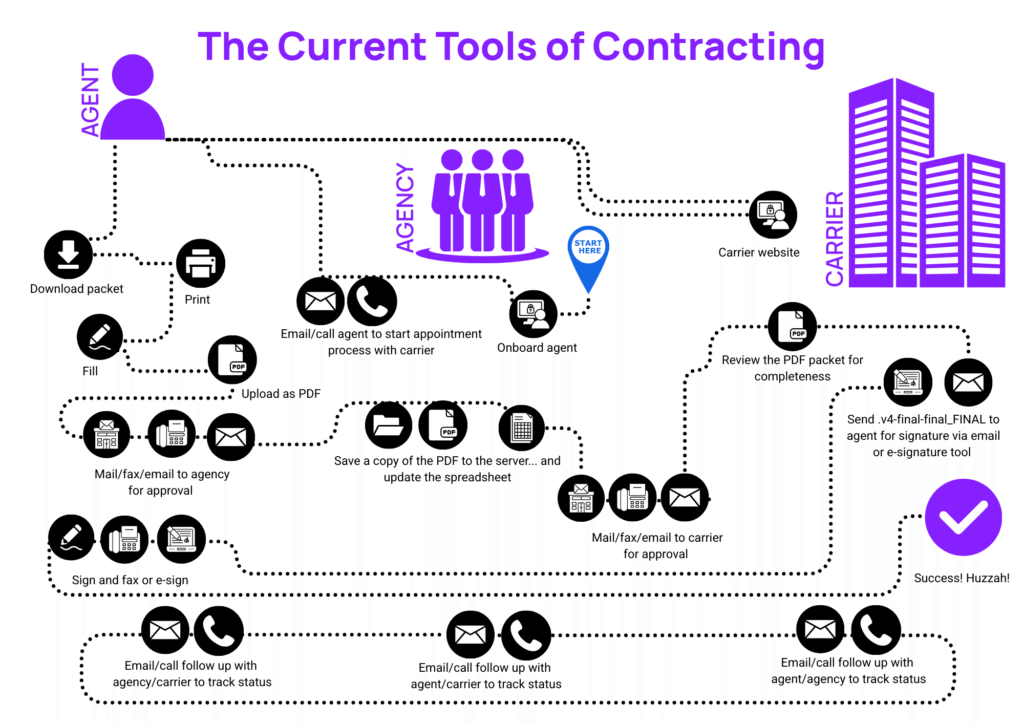
For insurance agencies that juggle just a few carriers, maybe the PDF hustle isn’t so bad. But for agencies that need to handle agents and their contracts across 20 carriers, in multiple states, with their uplines or downlines, and various commission rate structures, handling complexity without making it complicated is critical.
AgentSync Contracting is a contracting and appointment application solution that standardizes your agent data according to your carrier partners’ preferred data structures, validates that data against the industry source of truth, and autofills that data across their entire contracting profile. This means your agents don’t have to do repetitive data entry, your administrators don’t have to fact-check every agent application, and everyone works in one consolidated application workflow.
Key features include:
Some carriers dictate specific ready-to-sell processes, while others accept a variety of submission types for appointment applications. Regardless, we know “onboarding” across all industries is responsible for about 25 percent of churn, according to one customer retention company. When we’re zeroing in on the insurance industry, where turnover is massive in the first few years of a producer’s career, there’s reason to believe churn in the onboarding process is an even greater risk.
Independent insurance agencies primarily exist to lock in this process and get their agents ready-to-sell for carriers: The administrative lift at scale is what makes them attractive to carriers and agents alike. Yet the mechanisms for onboarding agents—the onboarding and contracting technology, or lack thereof—are often limited by carrier processes and sometimes trapped in the processes of decades past. And your Director of Contracting is tired of having to chase agents after submitting Not-in-Good-Order (NIGO) applications to carriers.
Today, the agent-to-carrier contracting process happens through a few different media:
Whether a carrier is living in a material world or they’re a digital maven, agencies may need any of the following technologies to support agents in their applications to get a contract and carrier appointment.
In paper’s defense, it was cutting edge back in the aughts. And yes, sometimes carriers still give agents the option of printing an application and busting out that ballpoint to kick off the contracting process.
Adobe Acrobat Reader, Preview, PDFescape, Canva… Similar to the printed page, many carriers have their packets as PDFs. If you’re lucky, they have fillable fields on their PDF forms. Often, if agents are submitting their contracting request through a carrier portal, it means they’re uploading a PDF.
For mid-tech solutions such as PDFs, you may be sending to a contracting@carrier email as a key piece of your process, or you may be sending via fax. And if you’re sending via fax, you’re going to also need a phone number, because no one ever believes the fax “made it.”
If you’re submitting your contracting packet via email or through a carrier portal, most teams are maintaining a spreadsheet in Excel or Google Sheets or Numbers. They’re manually tracking which producers have been submitted with what carriers and when, which means that each leg of the process requires someone to do the work and then write about how and when they did the work.
For the truly cutting edge, some carriers and agencies have managed to hand off this process with e-signature tools such as Docusign, Preview, Adobe Sign, Sign Now, PandaDoc, or SignEasy. However, implementing a digital signature or electronic signature tool hasn’t been the catchall solution for contract management in the agent-to-carrier contracting and onboarding process.
Quite a bit of this comes down to the fact that, if the information in the document is incorrect, then an agent can sign it and it still will be rejected as NIGO.
Agencies that want to get their agents ready to sell and burnish their reputation with carriers for having tight IGO apps aren’t afraid to get digital. That doesn’t mean digitizing manual processes. It means transforming your system for a fully in-app experience that means your administrators don’t have to jump between a spreadsheet, an e-signature tool, a carrier portal, and an email. Instead, by implementing a fullstack contracting solution, agencies simplify the process for agents, administrators, and their carrier partners alike, reducing churn, lowering NIGO rates, maintaining agency-to-carrier compliance, and tightening that agent appointment timeline.
Modernizing your contracting and appointment workflows isn’t optional. It’s essential for reducing NIGO rates, improving producer retention, and careating a carrier-ready onboarding experience. To learn more about how you can tighten your onboarding process without aggravating your admin staff; visit our Contracting page.

Get the latest updates on new insurance industry content.
Learn how AI-powered insurance claims automation helps insurance carriers, agencies, and…
Scaling means increasing revenue without proportionately increasing expenses. This is why…
BPOs can use tech to handle risk and operational complexity at…